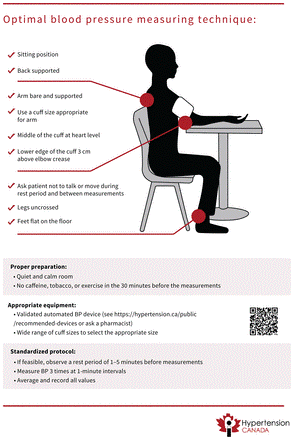
Values and preferences
The guideline committee placed a high value on using proper BP measurement technique and equipment to ensure accurate readings. As such, the recommendation prioritizes precision in BP assessment to ensure appropriate diagnosis and management. While recognizing that access to validated devices and standardized methods may be limited in some settings, this recommendation underscores the importance of maintaining measurement quality to reduce errors and improve clinical decision-making.
Out-of-office BP assessment is recommended to confirm the diagnosis of hypertension or to detect white-coat hypertension and masked hypertension (strong recommendation, moderate-certainty evidence).
Rationale
Out-of-office BP measurements (ABPM or HBPM) are useful to confirm the diagnosis of hypertension when office BP is elevated. Ambulatory BP monitoring measures BP at 20- to 30-minute intervals during both day and night.31 The standard protocol for HBPM involves measuring BP in duplicate twice daily for a week. Out-of-office BP measurements (particularly ABPM) correlate more closely with cardiovascular events and death than office BP measurements do. For example, a large observational study of about 60 000 primary care patients found that 24-hour ambulatory systolic BP was strongly associated with cardiovascular death (hazard ratio [HR] 1.51, 95% confidence interval [CI] 1.41–1.62) and all-cause death (HR 1.43, 95% CI 1.37–1.49), even after adjusting for office BP.32 Out-of-office BP assessment is also required to identify the common BP phenotypes of white-coat hypertension (BP elevated in office but not out of office, which is present in 15%–30% of people with elevated office BP)33 and masked hypertension (BP elevated out of office but not in office; prevalence of 10%–15%).33,34
When out-of-office BP measurements are not feasible owing to lack of accessibility, affordability, or adequate training for patients or caregivers, the diagnosis of hypertension can be confirmed with repeat office BP measurement using the standardized technique. Although reliance on single-visit office BP measurements to diagnose hypertension reduces specificity relative to ABPM,35 it may need to be considered in certain circumstances, such as for patients with infrequent office visits who are unable or unwilling to perform out-of-office measurements.
Values and preferences
The guideline committee prioritized the importance of accurate hypertension diagnosis by emphasizing out-of-office BP assessment. The recommendation places a high value on minimizing misdiagnosis from white-coat hypertension or masked hypertension, which could lead to unnecessary treatment or missed cases of hypertension. Although accessibility and feasibility of out-of-office BP monitoring may vary across different settings, this recommendation places greater importance on diagnostic precision over potential challenges in implementation.
The definition of hypertension in adults is recommended as BP ≥ 130/80 mm Hg when measured with a validated device under optimal conditions (strong recommendation, moderate-certainty evidence).
Rationale
Starting as low as with a systolic BP of 90 mm Hg, observational data have shown a continuous relationship between higher BP and risk for adverse cardiovascular outcomes.36 Yet for clinical care and public health purposes, it is helpful to establish a categorical threshold to define hypertension. In the present guideline, we set the BP threshold to define hypertension in adults at 130/80 mm Hg, a threshold below what was previously recommended by Hypertension Canada.31
The rationale behind this change is based on observational and randomized controlled trial (RCT) data on the relationship between BP and the magnitude of cardiovascular risk. Meta-analysis of prospective study data has shown that the relative risk for major adverse cardiovascular events for people with BP ≥ 130–139/85–89 mm Hg is 1.5-fold to 2.0-fold higher than for people with BP < 120/80, and a risk substantially higher than for those with BP 120–129/80–84 mm Hg.37 Similarly, RCT data on the effects of more intensive BP-lowering treatments have consistently shown their effectiveness in reducing the risk for major adverse cardiovascular events for people with BP ≥ 130/80 mm Hg (and in some cases for people with BP < 130/80 mm Hg), as discussed in the “Treatment” recommendations section.27,28,30,38–44
In adults with confirmed hypertension, routine testing should be performed to assess cardiovascular disease risk and screen for end-organ damage (Appendix 1, Supplementary Table 1, available at www.cmaj.ca/lookup/doi/10.1503/cmaj.241770/tab-related-content).
Values and preferences
The guideline committee placed high value on early detection and intervention by defining hypertension at a lower threshold (BP 130/80 mm Hg) than in previous guidelines. This reflects a high value placed on aligning with emerging evidence that associates cardiovascular risk with lower BP levels. Although this lower threshold will increase the number of people labelled as having hypertension, the recommendation emphasizes the benefits of earlier management in preventing long-term complications.